The topic of “generational marketing” is a relevant and timely one, both for our firms’ clients and for our internal communications strategies. As employees stay in the workforce longer than ever before, we find ourselves with four distinctly different generations working side by side, though often not seeing eye to eye. Choosing the most appropriate channel for communicating with a client or colleague can make or break your end result. Communicating with someone in a mode they don’t prefer can be as confusing and frustrating as someone speaking in a language you do not understand.
Traditionalists/The Silent Generation
This group, the most senior of the bunch, prefers formal communication: a person standing in the doorway with a question, legal pad in hand; a typed, carefully proofread document to reference; a protocol to call upon. They have been loyal to their firms or companies, and demand respect for their tenure. They often see more convivial communication styles as lacking in respect, and their propensity to be poorly versed in technology leaves them at wit’s end when it comes to responding to emails or other technological forms of communication. They would much prefer an in-person meeting, or at least a proper phone call, in order to deal with an issue promptly. Communicate with Traditionalists in-person when possible, and only as frequently as needed to achieve the desired results.
Baby Boomers/The “Me” Generation
As the pioneers of their day, this group is a little more laid back than their predecessors, while still valuing form and precision in communications. They were raised in a workplace where having a job was something to be proud of in and of itself, and that if you worked hard enough and stayed long enough, you would retire with a nice pension and a sense of accomplishment. This tends to create a desire for competition amongst workers in this generation, and an increased value placed upon awards and recognition. They hope to remain more “laid-back” than the generation that came before them, but still prefer concise communications, with a little more room for creativity. Communicate with Baby Boomers via face-to-face meetings or phone calls, and play to their competitive nature when possible.
Generation X/The MTV Generation
This group is often the most independent of the four, perhaps due to their upbringings as the first true “latchkey kids.” They value work/life balance, but don’t prefer one communication style over another. They are the most malleable of the generations, being able to see the value in face-to-face meetings with the older generations (and placing much value on in-person networking), but are also tech-savvy enough to communicate via email or chat functions at work with the younger generation. They may not want as much constant communication as the generation that follows them, but they do value feedback more than the prior generation. Communicate with Generation X in-person or electronically, but give them flexibility to respond in a mode that is most convenient for them and their lifestyle.
Generation Y/Millennials
This group wants a constant stream of real-time information, and doesn’t mind working outside of the traditional 9-5 hours as long as there is flexibility involved. They heavily value their work/life balance, and are tech-savvy enough to find efficiencies to be able to work from wherever, whenever. Gen Y prefers e-mail or text correspondence, and doesn’t mind collaborative back-and-forth. Social media is a completely acceptable form of communication. Face-to-face brainstorming speaks to the collaborative nature of this generation, but they are unlikely to make phone calls or leave voicemails, as their management-level colleagues may prefer. Communicate with Millennials electronically, as often as necessary, and provide feedback and input whenever possible which helps them feel valuable.
If you frequently consider the demographic of your audience, as well as the differences between theirs and your own, you may find that communicating between the different generations in today’s workforce is much easier that it seems.
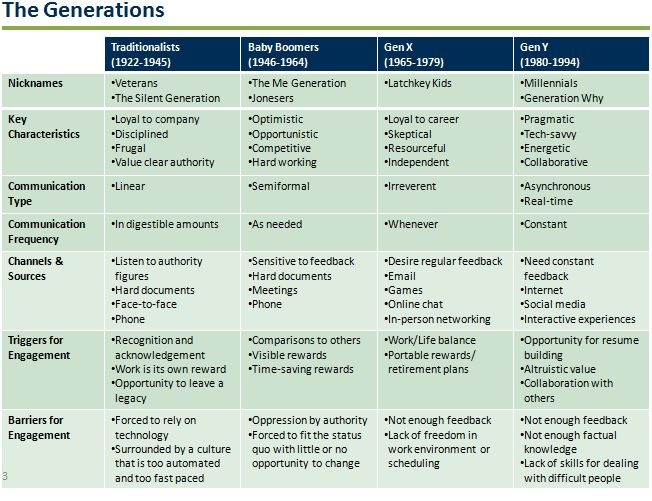
Source: The ROC Group
By Jenna K. Schiappacasse, Director of Marketing at Rosenberg Martin Greenberg, LLP, for the September-October issue of Capital Ideas.