 Director of Business Development
Cassels Brock & Blackwell LLP, Toronto
Many years ago, I asked my cousin Rebecca, who works for a company that manufactures three-ring binders, if she was worried about losing her job with the advent of the paperless office. “Of course not,” she replied without missing a beat. “Where else would everyone keep all that useless stuff they’ll be printing off their computers?”
Much time passed, but towards the end of every year I couldn’t help but think about Rebecca’s prediction every time I saw a lawyer dutifully (and as if under duress) fill out some planning form or another, insert it into a binder and place the binder into a drawer or onto a shelf, never to be seen or heard from again.
There had to be a better way...
Not only did the planning process seem like such a waste of time, but it also took a toll on my patience as I listened to the litany of complaints about the futility of it all. So I got to thinking. What if we could make the content of those planning and budgeting forms integrated and dynamic, just like the records in our CRM or the information in the backend of our website? What if the lawyers truly believed – even saw evidence – that their plans were being reviewed, considered and maybe even utilized? What if (and this was a big if), some of them even saw some value in the process for themselves?
And that, in a nutshell, is how I finally launched a completely electronic database-driven planning and budgeting process that takes everything our lawyers input into a template and actually makes it accessible and useful to everyone all the time.
How it works
On the surface, it’s very basic. We worked with Andrew Bartle of Codestorm, who developed the backend of our website, to create a very simple, extremely cost-effective eight-tab template using the same software. The areas covered are all standard and won’t come as a surprise:
Plans: This is where the lawyers outline their key business development goals for the year (develop my profile in the widget industry, champion the cross-selling of specialty services to ABC Corp., become an expert in the new legislation, etc.).
Teams: This tab contains a drop-down menu so that lawyers can select those client, industry or firm-wide initiative teams in which they are involved.
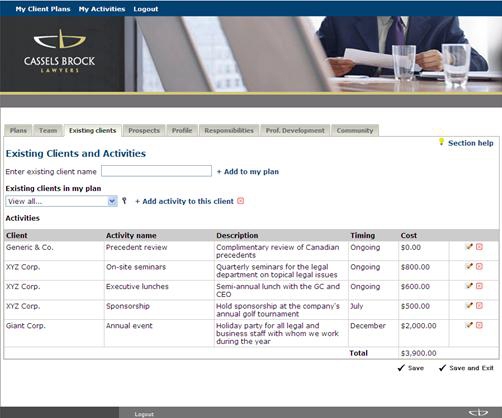
Existing Clients: The objective here is not to list every client for whom the lawyers work but rather to identify a select number of key clients who will require exceptional or coordinated maintenance or who represent a strong growth opportunity. Lawyers are reminded that, in addition to the more traditional entertainment and educational activities everyone undertakes, they should consider the ways in which they can incorporate development activities into the normal course of file work.
Prospective Clients: Along the same line as the ‘Existing Clients’ tab, this is the place to list specific companies or individuals who represent entirely new revenue opportunities.
Profile: In this tab, lawyers list the ‘target audiences’ that are the most important to them (based on industry, function or geography, for example) and the activities they’ll undertake to create and build a strong reputation among those important groups.
Firm Responsibilities: There is a pull-down menu here listing all firm committees and firm management roles.
Professional Development: This is the tab where CLE and soft skills training are contemplated.
Community Involvement: In this tab, lawyers note the volunteer work they’ll be doing for charitable, cultural and civic organizations, including any time they’ll spend with the firm’s Dare To Care initiative.
Easy to use
Lawyers access the personal planning and budgeting template from a link on the firm’s intranet. Navigation is quick and easy. The fields are finite in size, necessitating succinct and well-considered content. When the template is filled, there is no submission process. A click on ‘Save and Close’ deposits all of the information into a central relational database.
Here is an example of the Existing Client Tab:
The Real Value
It’s the database that adds the real utility to the process because it makes all of the planning information accessible for viewing and capable of being manipulated by the practice group leaders, operations committee, executive committee, business development team members and other interested firm members. Here are some of the ways in which the lawyers and firm benefit:
- The link remains active year round to allow for regular review, updates and progress reporting. It’s not necessary to save a plan in the document management system or send revised copies around because it’s always available to anyone who needs it in real time on the intranet.
- A practice group leader can, at any time, review and sort all of the activities being recorded in each of his or her group’s plans in aggregate. For example, a practice group leader may want to spend time analyzing only the prospects identified by group members to identify duplicates, synergies and trends. Such reports can be created in seconds. Of course, individual plans can also be accessed.
- With all of the records in a concise, categorized format, the content of all of the plans, some of the plans or portions of the plans can be imported into an Excel spreadsheet with a few clicks of the mouse. Although (admittedly) such spreadsheet can be a little bit daunting, it’s an efficient way for Executive Committee members or Business Development staff to peruse and assess the data en masse in light of the firm’s overall objectives.
- Budget requests are automatically calculated and totalled based on the associated cost of each proposed activity recorded.
- Younger lawyers have access to the plans of more senior lawyers, which helps them to establish the direction and content of their own plans.
- The rate of plan completion increases because, for the most part, the lawyers find database planning to be more logical and more efficient than document-based planning. Of course, the fact that they now see evidence of when and how their plans are being assessed and utilized for group and firm-wide purposes is the biggest motivator of all.
Conditions for success
And that brings me to an important caveat. This method of planning works for our firm because there is a strong desire on the part of senior firm management to make thoughtful planning and aggressive plan implementation a cornerstone of our business development culture. The process and tools we have developed streamline the work and help us to achieve our objectives, but they are only as good as our level of commitment.
So, back to my cousin Rebecca, whose job is secure because thousands of lawyers around the world are still producing reams of paper plans to fill her binders. But don’t come knocking on my door, Rebecca, because I’m not buying binders anymore.