
 |
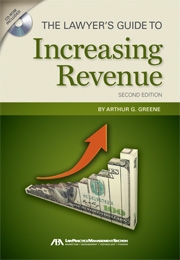
| The Lawyer's Guide to Increasing Revenue, Second Edition, by Arthur G. Greene (ABA, 2011) |
As the legal marketplace continues to become more competitive, the responsibilities of legal marketing professionals continue to evolve, to keep pace with the changing landscape. Just as we remind our lawyers of the importance of understanding their clients’ businesses so that they can render more valuable counsel, we would be wise to heed our own advice and strive to better understand the business aspects of our law firms. In doing so, we not only ensure that our contributions support the overall business strategy of the firm, but we can strengthen our attorneys’ perception of us as their trusted advisor.
If you’d like to boost your knowledge of the factors affecting any law firm’s profitability, a good place to start is The Lawyer's Guide to Increasing Revenue, Second Edition, by Arthur G. Greene. The truth of the matter is that the great majority of law firms have untapped revenue potential—they leave money on the table every year. Yet when strategizing how to improve their financial success, all too often they focus primarily on reducing costs, raising hourly rates, and increasing billable hours. Ultimately, they find that not only do these steps fail to achieve the desired results, but client satisfaction and lawyer morale are negatively impacted.
This book sets out to show lawyers how to move beyond short-term fixes such as cost-cutting and instead reevaluate and adjust their management concepts and business methods with the goal of enhancing revenue using the firm’s existing resources. Author Arthur Greene demonstrates how increasing revenue, while maintaining the same expense structure, is the most powerful approach to improving the firm’s bottom line. In laying out these methods in clear and practical terms, Greene draws upon over 35 years of law practice, including long stretches as managing partner, and his subsequent years of working with firms to improve their business management practices to support financial growth.
Part I of the book presents the best approaches for increasing revenue in the short term, including chapters on how to develop a revenue mind-set, understand all-important financial indicators, establish revenue capacity, track results, and look for revenue.
Part II continues with recommendations that will have a positive impact once implemented, focusing on a so-called “Undiscovered Secret for Achieving Better Revenue.” Of particular interest to marketers is the fact that difficulty meeting client expectations can be tied directly to a firm’s financial struggles. It may seem obvious to us that ensuring client satisfaction is key to a firm’s success, but there are still lawyers who do not connect the dots. The chapters in this section explain, step by step, how to heighten the significance of client intake, manage client expectations, keep clients grateful, ensure prompt payment, and nurture clients so they end up being your best marketing tools.
Part III focuses on how leveraging is critical to strengthening the firm’s revenue potential in the long term. In these chapters, we learn about leveraging expertise, the different types of value-based fee arrangements, the firm’s technology, and the growing role of paralegals.
Finally, Parts IV and V set out to assist firm management with transitional issues and the process of achieving the necessary changes in a firm’s operation. Part IV includes detailed discussion on billable hour expectations and accountability, billing rates, and collections. Part V addresses common but significant obstacles to improving revenue, and how to overcome them. These chapters cover how to create meaningful financial reports, use partner compensation as a management tool, enlist practice group leaders, empower leadership, and embrace change.
Throughout the book, Greene emphasizes that the best approaches to improving financial indicators are those that also improve client satisfaction, which is key to keeping revenue flowing. As the best lawyers know, it’s all about the client. And while addressing client issues, it’s also important to find ways to improve the firm’s practice methods and its approach to leveraging internal resources. As marketers, we can be instrumental in assisting management to achieve the firm’s financial goals.
An accompanying CD features sample policies, worksheets, plans, and other documents designed to help implement the concepts described in the book. To read more about this title and review the complete table of contents, visit the ABA bookstore.
I asked Arthur Greene to share more insight into how law firms can improve profitability. Here’s what he told me:
Q: Arthur, you wrote the first edition of this book in 2005, before the economic upheaval that rocked the legal industry. How was the advice in your revised edition, written last year, impacted by the changes law firms encountered as a result of the downturn?
AGG: The second edition has a number of new chapters, including several that focus on changes in the concept of law firm leverage. In recent years, associate leverage has been harder to achieve due to client scrutiny. As a result, many successful firms are focusing on leveraging paralegals, technology, and the use of alternative billing methods. In fact, firms that are moving away from the billable hour are achieving the greatest success in these competitive times. Alternative billing methods are becoming an important marketing tool for some firms.
Q: What is one common practice you see time and again that is an obstacle to a firm's financial success but that can be more easily remedied than one might think?
AGG: From my experience with law firms, the one factor that is always at the top of the list is the failure of the lawyer to create realistic expectations during client intake. In particular, it involves the lawyer’s failure to communicate a realistic fee estimate and establish with the client the expectations of the law firm as to payment. Chapter 6 provides practical advice on how to communicate those expectations at the beginning of the engagement, as well as how to deal with any unavoidable changes in the fee estimate. Chapter 9, “Find the Magic: Payments by Return Mail,” provides a strategy intended to elevate the lawyer/client relationship to a point where most clients will pay their legal fees promptly.
Beverly A. Loder is Marketing Director at Fitch, Even, Tabin & Flannery LLP and Editor of In the Loop. She can be contacted at bloder@fitcheven.com.